Molecular Mechanisms of Fast Synaptic Transmission: Structure, Function, and Modulation of Ion Channels
Our overarching research goals are to develop a molecular-level understanding of ion-transport phenomenon across cellular membranes that occurs under normal and pathophysiological conditions. Our current focus is on ion channels that mediate fast synaptic transmission at the neuronal and neuromuscular junction; namely, ligand- and voltage- gated ion channels. These channels play a central role in cellular excitability, and dysfunctions are associated with a number of neurological disorders such as epilepsy, Congenital Myasthenic Syndrome, Schizophrenia, Alzheimer’s disease, and chronic inflammatory pain. Consequently, these channels are important clinical targets.
Ion channels have evolved to undergo rapid conformational changes in response to stimuli and thereby tightly regulate ionic fluxes and thus the cell physiology. They have varied architecture and broadly differ in their sensitivity to stimuli, activation timescales and ionic selectivity. This structural and functional diversity allows them to critically govern the rate, duration and amount of current and as a result impact a multitude of cellular processes. The work in our lab over the past decade has been to uncover the molecular basis for fundamental processes of ion channel function that involves stimuli sensing, channel gating, ionic selectivity, and drug recognition and modulation.
Another area of emphasis of our research is to understand the critical interaction between ion channels and membrane lipids, and how this interaction is altered in the presence of allosteric modulators such as neurosteroids, alcohols, and anesthetics. Our scientific approach is a unique combination of cutting-edge multidisciplinary tools that includes single-particle Cryo-Electron Microscopy (Cryo-EM) and X-ray crystallography for high-resolution structure determination, Electron Paramagnetic Resonance (EPR) spectroscopy for protein dynamic measurements, and patch-clamp electrophysiology for functional characterization of ion channels. Findings from these techniques complement each other and allow, at unprecedented detail, an atomic level description of how structure and dynamics govern ion channel function. Guided by these new insights we are now developing novel strategies for rational drug design in serotonin (3A) receptors and glycine receptors.
Research Figure Title
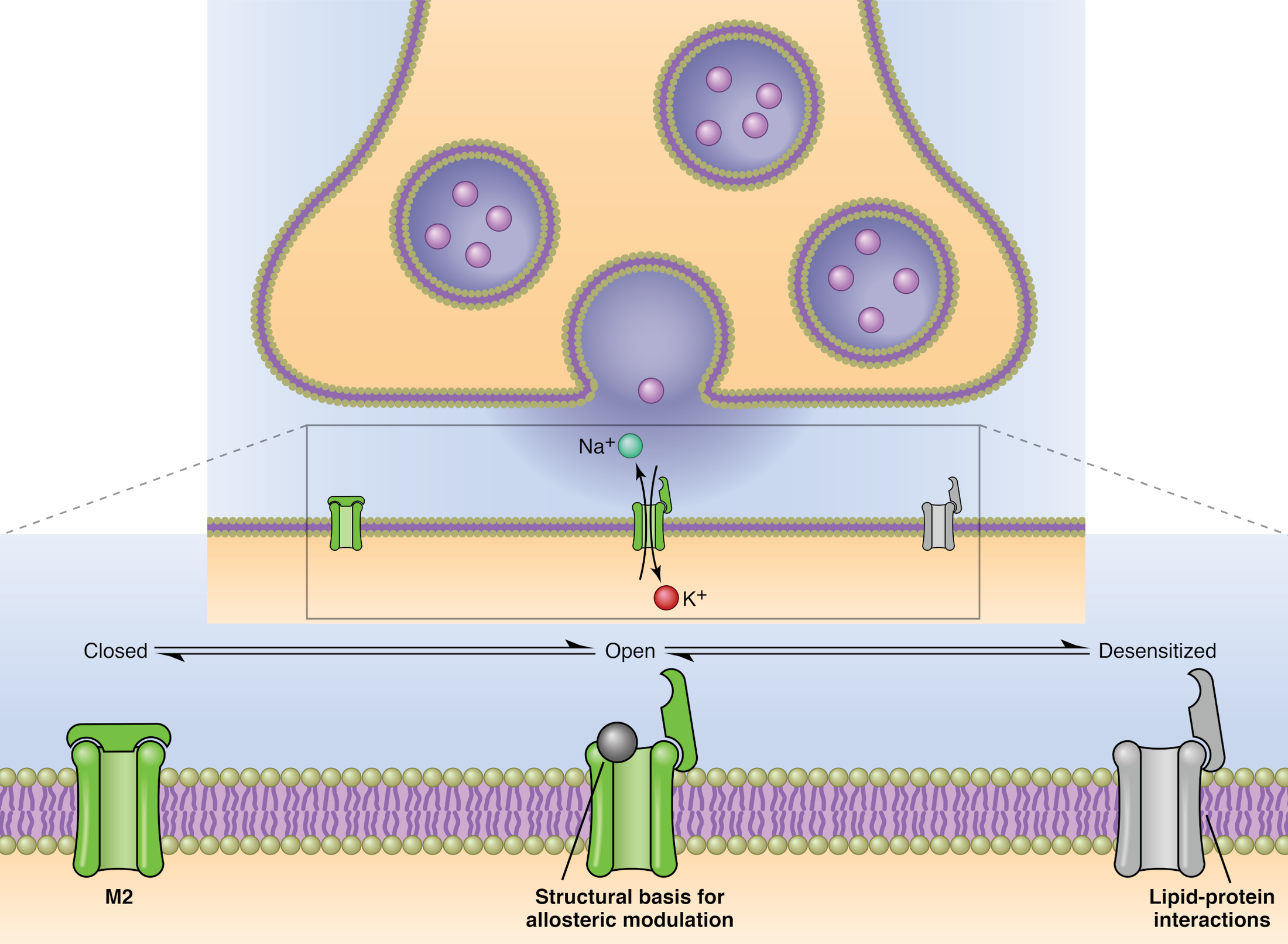
Research Figure Legend
| Major Research Areas |
|---|
| Ion Channels, Protein Structure/Function, Structural Biology, Synaptic Transmission |
| Disciplines |
| Cryo-Electron Microscopy, Electron Paramagnetic Resonance, Electrophysiology, X-Ray Crystallography |
| Organ Systems |
| Cardiovascular System, Gastrointestinal System, Nervous System |
| Diseases |
| Channelopathies, Epilepsy, Neurological Disorders, Pain |
| Major Techniques |
| Cryo-Electron Microscopy, EPR, Electrophysiology, X-ray Crystallography |